Tankless Water Heaters in Manotick: what to know before the next step
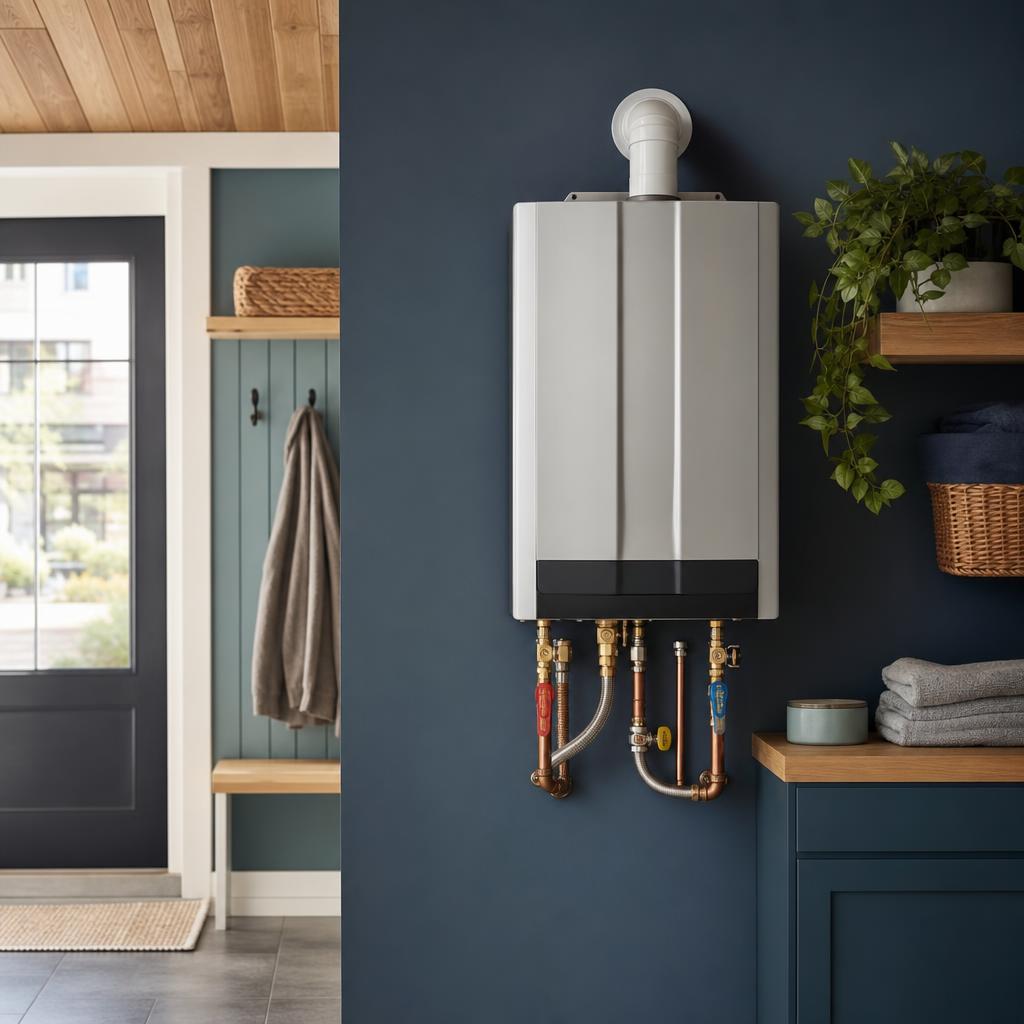
Illustrative AI-generated image, not a photograph of local work or a provider.
A tankless water heater can change how a Manotick home produces hot water, but “on demand” does not mean unlimited, instant, or automatically economical. This guide focuses on flow rate, inlet temperature, energy supply, maintenance, comfort, and installation trade-offs so homeowners can ask better questions. Read the water heater installation guide for broader replacement planning and use the request route only to discuss your own property with a qualified provider. ManotickPlumber.com is an information and service-request resource; it is not an operating provider and does not promise prices, availability, emergency response, coverage, or outcomes.
How a tankless system actually works
A tankless heater activates when water flows through it, transferring heat as the water passes rather than storing a large reserve. That can reduce standby storage but places emphasis on activation flow, heat-transfer capacity, inlet temperature, and the energy available to the appliance. “Endless hot water” is therefore conditional: the unit can continue heating within its rated flow and temperature range, but it cannot exceed those limits or ignore simultaneous demand.
Begin with the household pattern. List showers, tubs, faucets, laundry, and dishwasher use that may overlap, then identify whether the complaint is quantity, waiting time, temperature stability, or space. The water heater service page provides a broader symptom framework. A provider should translate the demand pattern into a capacity discussion and explain assumptions rather than quoting a model number without showing how it fits.
Flow rate, temperature rise, and winter reality
A tankless unit must raise incoming water to the desired outlet temperature while delivering a particular flow. Colder incoming water requires more heating work than warmer water, and a high-flow shower or filling tub demands more than a handwashing tap. If several outlets run together, the appliance may reduce temperature, limit flow, or fail to meet the set point. Ask for performance at realistic simultaneous demand, not an ideal laboratory headline.
Low-flow fixtures can fall below the activation threshold, while partially closed valves, clogged filters, or scale can reduce performance later. A mixing valve or fixture cartridge can also create symptoms that look like heater failure. Do not increase temperature to compensate without understanding scald risk. The bathroom plumbing guide can help separate fixture behaviour from water-heater behaviour before a replacement decision is made.
Energy supply and installation feasibility
Tankless equipment can require substantial electrical capacity, fuel delivery, venting, combustion air, condensate handling, or a combination of these depending on design. Existing connections are not proof that a new unit can be installed without modification. A replacement may require a new circuit, vent route, gas line assessment, drainage path, or mounting arrangement. Those interfaces should be considered before the unit is purchased.
Never modify fuel, venting, electrical equipment, or combustion-air provisions as a shortcut. Ask which portions are plumbing, which require another qualified trade, and who coordinates inspections or approvals where applicable. The renovation plumbing page is helpful when a utility room is being redesigned. This resource does not make local regulatory claims; confirm current requirements with the appropriate qualified professionals and authorities.
The cold-water sandwich and waiting time
A tankless heater may reduce storage-related standby loss but cannot make water arrive at a distant fixture instantly. Water sitting in the pipe cools between uses, so a user may feel a cool interval before heated water reaches the tap. Short draws can also produce noticeable temperature changes depending on controls and layout. A recirculation arrangement may address comfort in some homes, but it adds design, energy, maintenance, and control questions.
Ask whether the proposed system is intended to improve capacity, comfort, space, or operating efficiency, because each goal can lead to different design choices. A recirculation pump is not a universal fix and should not be installed without considering return piping, controls, and sanitation. The kitchen plumbing guide offers context for fixture distance and everyday demand. Test the actual complaint instead of assuming a new heater solves every wait.
Scale, water quality, and maintenance
Heat exchangers can accumulate mineral scale, especially where water chemistry and temperature encourage deposits. Scale may reduce heat transfer, narrow passages, trigger error codes, and make temperature less stable. Maintenance requirements vary by equipment and conditions; a generic annual promise is not a substitute for the manufacturer’s instructions or a site-specific recommendation. Ask what signs indicate service and how isolation for maintenance is arranged.
Filters, isolation valves, service ports, condensate components, and venting should remain accessible. Do not remove covers or work around fuel and electrical parts because a display shows an error. Record error codes, timing, flow conditions, and whether the issue affects every fixture. The plumbing repair page can help frame a service request when a tankless unit is malfunctioning, while the home checklist helps preserve model and shutoff information.
Sizing a home rather than a marketing claim
Sizing is a calculation and conversation, not a contest for the highest output. A system should match peak flow, desired temperature, inlet conditions, energy availability, venting, and the home’s practical usage. Oversizing may increase installation demands and cost without improving a fixture that cannot use the extra flow. Undersizing can produce disappointment when two showers overlap or a tub fill competes with another outlet.
Ask the provider to state the proposed flow and temperature assumptions, the expected performance during simultaneous use, and the result of limiting one fixture. If an existing tank never ran out, determine whether the goal is space, recovery, efficiency, or a renovation constraint. The water-heater installation page explains proposal comparisons. A transparent recommendation acknowledges uncertainty where household use or concealed infrastructure is not yet known.
Safety and household operation
Hot water can scald, and a higher set point can increase injury risk even when a system is functioning correctly. Learn the controls, keep children away from accessible hot taps, and ask how temperature is controlled at fixtures. Never bypass an error, relief device, flame safeguard, or sensor. Keep required clearances and air paths unobstructed, and do not store combustibles beside equipment where that is unsafe.
Know the water and energy shutoffs, but operate unfamiliar controls only with clear instructions. If you smell fuel, see flame where it should not be, notice scorching, or suspect carbon monoxide, leave the area and use appropriate emergency resources. This website is not an emergency dispatch service. For flood concerns around a utility area, the basement protection guide discusses layered planning without claiming that any accessory prevents every loss.
Installation proposals and long-term value
Compare tankless proposals by total scope: equipment, mounting, water connections, filtration, venting, fuel or electrical changes, condensate drainage, recirculation, removal, commissioning, and future access. Ask who supplies each component, who handles work outside plumbing scope, and what assumptions could change the proposal. A low equipment price can be misleading if essential infrastructure is omitted. Written exclusions are useful, not automatically a warning sign.
Evaluate benefits against maintenance, waiting time, demand limits, installation disruption, and expected service needs. Cost depends on the appliance, access, energy modifications, and site conditions; this resource offers no universal price or savings guarantee. The plumbing cost factors guide is for questions only. Verify provider qualifications, insurance, warranties, approvals, and timing directly, because the site does not represent an operating installation company.
Long-term value also includes how easily someone can reach the controls, isolate the water, clean an inlet filter, and service the heat exchanger. A system that performs well but is boxed into an inaccessible corner can be frustrating later. Before the walls or cabinets close, photograph accessible valves and record the model and serial information. Clear documentation supports future troubleshooting without suggesting that every later repair will be simple.
Questions about tankless water heaters in manotick
Does a tankless water heater provide unlimited hot water?
It can continue heating while flow stays within its rated capacity and the available energy can provide the required temperature rise. Multiple high-flow fixtures, cold incoming water, or a unit that is too small can still limit temperature or flow. “Endless” is not a promise of unlimited simultaneous demand.
Why does my tankless water feel cold for a moment?
Water sitting in the supply pipe cools between uses, and the heater also needs flow to activate and time to transfer heat. Distance, fixture flow, controls, and recirculation design affect comfort. A new heater alone may not eliminate the waiting interval.
How often does a tankless heater need maintenance?
It depends on the equipment, water conditions, use, and manufacturer instructions. Scale, filters, valves, venting, and condensate components may need attention. Ask a qualified provider for a condition-based plan rather than relying on a universal interval or ignoring error codes.
Can my existing gas or electrical connections support tankless?
Not necessarily. Tankless equipment may require different fuel delivery, electrical capacity, venting, combustion air, or condensate handling. Have the complete installation assessed before purchasing and never modify those systems casually.
Is tankless automatically cheaper to operate?
Operating cost depends on demand, energy source and rates, set temperature, water use, equipment efficiency, maintenance, and installation. Reduced storage can be beneficial in some homes, but installation cost and usage patterns matter. Ask for assumptions rather than accepting a guaranteed savings claim.